Boundaries, Authenticity & Mental Health in Relationships

In today’s world, relationships are evolving in ways that reflect deeper self-awareness and a stronger focus on mental health. More than ever, people are realizing that boundaries, honesty, and vulnerability are not barriers to connection—they are the very foundation of it. Whether you’re navigating the impact of social media, discussing mental health with a partner, or figuring out what healthy communication looks like in your relationship, these values are at the center of it all.

The Importance of Boundaries

Boundaries are not about pushing people away—they’re about creating space for respect and safety. In relationships, emotional boundaries help define what feels supportive versus what feels overwhelming. For example, knowing when you need alone time, how much energy you can give during stressful periods, or how you want to be spoken to during conflict can prevent misunderstandings from becoming destructive patterns. Healthy boundaries are not rigid walls, but flexible guidelines that honor both partners’ needs.

Authenticity Builds Trust

Authenticity means showing up as your real self, without hiding behind masks or trying to meet unrealistic expectations. In relationships, this can look like being honest about your struggles, sharing your values openly, and resisting the urge to curate a “perfect” version of your life for others—especially on social media. When authenticity is at the heart of connection, trust grows naturally. Partners can feel more secure knowing they are loved for who they are, not for who they pretend to be.

Vulnerability as Strength

For many, vulnerability still feels uncomfortable—it can seem like exposing your flaws or weaknesses. But in truth, vulnerability is where intimacy lives. Opening up about your fears, past hurts, or mental health challenges allows your partner to support you more fully. It also creates opportunities for mutual growth, showing that strength comes from sharing life’s weight together rather than carrying it alone.

Navigating Mental Health Conversations

Mental health is no longer something to keep hidden in relationships. Couples are increasingly acknowledging that anxiety, depression, burnout, or trauma may show up at different times, and that supporting each other requires patience and empathy. Healthy communication means asking your partner what kind of support they need, rather than assuming. It means listening without judgment, validating their feelings, and also respecting your own capacity. Sometimes supporting a partner may involve encouraging professional help, while other times it’s simply being present.

Social Media’s Influence

Social media has added a new layer of complexity to modern relationships. Comparison, performative posting, and the pressure to maintain appearances can quietly erode authenticity. Couples who thrive often establish digital boundaries—deciding what they share online, when to unplug, and how to prioritize real-life connection over curated feeds. By talking openly about how social media impacts each partner, couples can avoid unnecessary tension and build more genuine intimacy offline.

Redefining Healthy Communication

Ultimately, healthy communication today is about more than “talking it out.” It’s about listening with presence, honoring differences without defensiveness, and speaking with clarity instead of criticism. Healthy communication balances honesty with kindness, accountability with compassion, and self-expression with openness to the other person’s perspective.


Final Thoughts

Boundaries, authenticity, and vulnerability aren’t just buzzwords—they’re essential for sustainable, fulfilling relationships. By respecting personal limits, embracing honesty, and engaging in supportive conversations around mental health, couples can create stronger bonds built on trust and resilience. In a world where social media and stress often pull us away from connection, choosing authenticity and healthy boundaries brings us closer to the relationships we truly want.

Ready to talk? Schedule your session with SouthEnd Psychiatry today.

Mastering Post-Summer Mental Reset

As the long days of summer wind down and routines begin again, many people feel a shift in energy. The transition into fall can bring renewed focus, but it can also feel overwhelming if you don’t pause to reset. At SouthEnd Psychiatry, we believe this season is the perfect time to take stock of your mental health and enter the next chapter with intention.

Reset Healthy Boundaries

During the summer, schedules often become more relaxed—late nights, spontaneous trips, or extra commitments. As you return to school, work, or busier routines, now is the time to reestablish clear boundaries. Ask yourself:

  • Am I saying yes to too many things?
  • Do I have dedicated time for rest and self-care?
  • Are my digital habits (like screen time) supporting or draining me?

Healthy boundaries not only protect your time and energy but also strengthen relationships by setting realistic expectations.

Reflect on Summer Growth

Even if summer felt chaotic, there are always lessons hidden in the season. Did you discover a new hobby? Spend quality time with family? Learn more about what energizes—or depletes—you? Take a few minutes to journal about your highlights and challenges. Reflection helps you carry forward what worked well and let go of what didn’t.

Set Next Steps for Balanced Well-Being

With clarity on your boundaries and lessons from the summer, it’s time to set simple, achievable goals for the months ahead. That could mean committing to a consistent sleep schedule, scheduling therapy sessions, or planning weekly downtime. Think of these as “anchors” that keep you balanced as life speeds up.

Moving Forward with Intention

Transitions can feel stressful, but they’re also opportunities to realign with what matters most. By resetting boundaries, reflecting on your growth, and setting intentional next steps, you can create a strong foundation for mental wellness this fall.

At SouthEnd Psychiatry, we’re here to support you in making these changes stick. Whether you’re a student, parent, or professional, we can help you navigate the post-summer reset with tools that last well beyond the season.

Ready to refocus? Schedule your session with SouthEnd Psychiatry today.

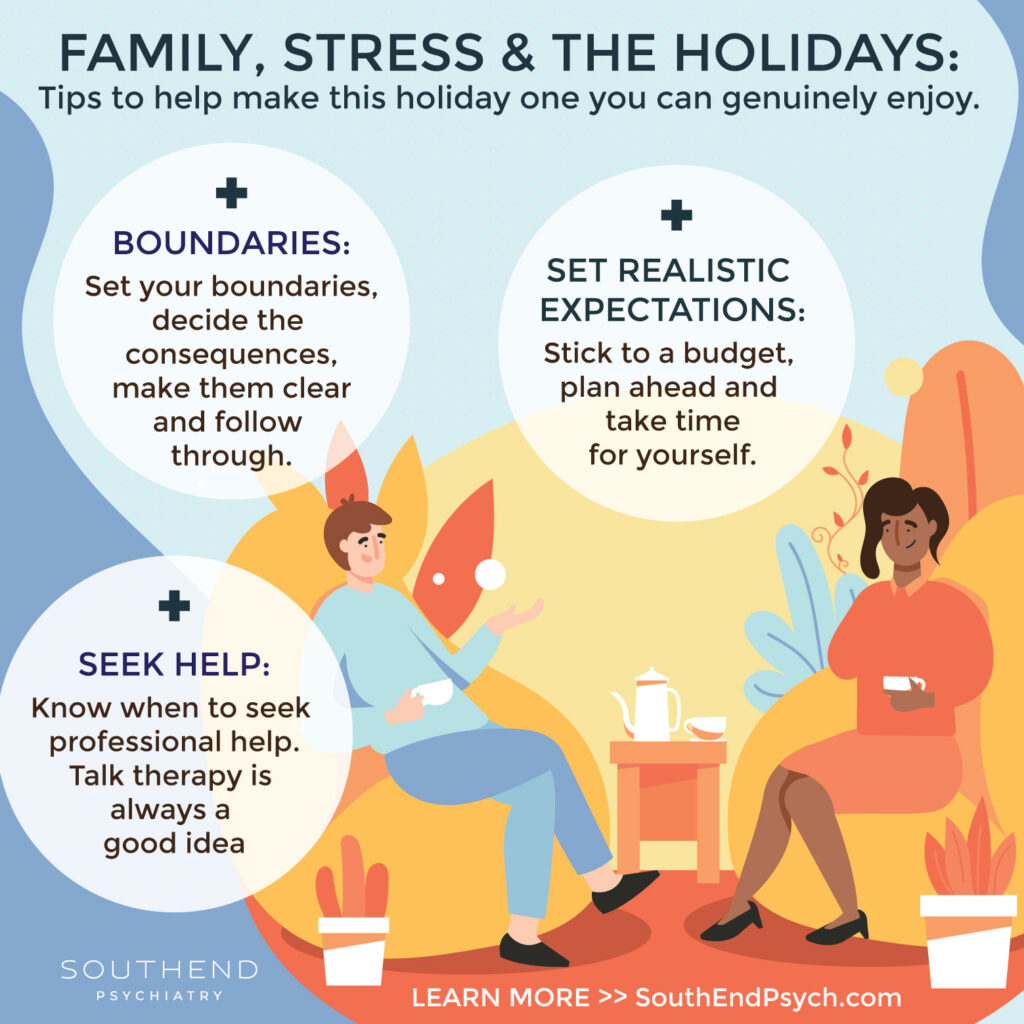
Family, Stress & the Holidays

When you think of the upcoming holiday season, does it immediately raise anxiety and stress levels? If so, you are not alone. This season can sometimes bring unexpected gatherings with toxic family members, an overcommitment of gift-giving, streets full of impatient drivers, and the stress of managing it all.  

There is hope. Believe it or not, we can all still have a joyous holiday despite the stressors that come with this season. Here are some practical tips to help make this holiday one you can genuinely enjoy.

Boundaries. Boundaries. Boundaries.

Boundary issues can be the most difficult to handle at the family level. It can feel uncomfortable if we haven’t practiced this skill. Start with these 4 rules:

  • Set your boundaries. What will you tolerate and not tolerate? What behaviors will you accept and not accept? Include everything from protecting your schedule to how someone can treat you. Write them down and trust your decisions. 
  • Decide the consequences. Most of us have at least one “boundary breaker” in our family therefore decide ahead of time what the consequences will be if your boundary is broken…regardless of who breaks it.
  • Communicate clearly. Make your boundaries and consequences known…especially with family members who are known to cross the line. Be direct and clear. Their response or reaction is not your responsibility.  
  • Follow through. If a boundary is broken, you know what to do. Be firm yet compassionate. Honor yourself by not allowing people to treat you poorly.

Set Realistic Expectations.

For some reason, we can feel like the holidays have to be perfect or even better than last year. We try to top last year’s gift list or attend more parties. FOMO (fear of missing out) is a real struggle for many however it comes at a cost. Consider these ideas:

  • Stick to a budget. Decide ahead of time how much you can afford and stick to it. If you are someone who loves showering people with gifts, think of ways to do this without overspending.
  • Plan ahead. Choose specific days for shopping, baking and family gatherings. Avoid last minute trips to the store by planning your menus and shopping lists in advance. 
  • Take time for yourself. This season is meant to be enjoyed by all…including you. Even setting aside 15 minutes a day alone to take a walk, read, or meditate can drastically reduce stress.

Know When to Seek Professional Help.

Talk therapy is always a good idea…especially when it is with a licensed therapist. If you are feeling persistently anxious, unable to sleep at night or focus during the day, let’s talk. 

Southend Psychiatry is here as you navigate the pressures, demands and triggers of the holidays. We can come alongside you to offer support and help. Contact Southend Psych today to inquire about appointment availability and get on your way to a better you.

Southend Psychiatry 

Schedule your appointment today with one of our SouthEnd Psychiatry clinicians. Book your appointment online or call 1-800-632-7969 to get started today.

How to Establish Healthy Boundaries

Who wouldn’t like to say that they have perfect relational boundaries?

While perfection might seem pie-in-the-sky, working on boundaries truly does strengthen them. The effort definitely pays off. Many times, the most difficult part of boundary work occurs when the boundary is established. Calmly and directly stating the boundary to your friend, colleague, or family member can seem intimidating; however, this step sets up the boundary to truly have a positive impact on your own mental health.

We all need healthy boundaries in our lives.

A boundary is where one person ends and you begin. If you feel yourself succumbing to agreeing to events you would rather not attend or people-pleasing your way through life, you need to take the first step and set a boundary.

Boundaries are not mean.

They help you grow and care for yourself. Many people and families have dysfunctional ways of relating, and in the beginning it can feel mean or generate guilt to establish firm boundaries. But, boundaries serve to strengthen the individual setting them and allow others to make decisions about their own lives, leading to more contentment and lower anxiety and depression.

An example of a simple boundary might be, “I am unable to attend the event this weekend.” Terri Cole, author of Boundary Boss lists in her “Boundary Boss Bill of Rights” that “you have the right to say no (or yes) to others without feeling guilty.” Taking the first step and deciding for yourself the best use of your time is boundary work that can reap dividends in peace of mind. 

Whether you are dealing with a co-worker who relies on your advice too often or a family member who is disrespectful, boundaries can make an impact on the quality of not only how you feel about your interactions with others and relationships in general, but also help your confidence increase as you begin to set healthy boundaries with those around you. 

Schedule your appointment today with one of our SouthEnd Psychiatry clinicians. Book your appointment online or call 1-800-632-7969 to get started today.

Book Appointment

PLEASE CLICK BELOW TO BOOK YOUR IN-OFFICE VISIT

Smiling woman booking an appointment on her phone